Showing posts with label students. Show all posts

21 October 2014

Student motivation, AKA Please take my class.

My current homework for Software Carpentry instructor training is to think about a time when I lost my motivation to learn. I posted my response to the SWC blog, where you can also poke around a see other folks' stories (click on the "Motivation" tag).

The other part of our homework is to work on a three-minute pitch to motivate students to learn a particular topic. The timing of this assignment is fortuitous, as I'm also promoting the bioinformatics class I'm teaching next spring as well as an undergraduate minor in bioinformatics and genomics. I took to twitter with my attempts at persuasion:

Disclaimer: I am not planning on physically harming students if they have a different shell preference than bash, and I don't particularly dislike perl. I'm really just rather fond of word games.

A few other folks chipped in with their own token words of wisdom:


It's not surprising that my motivation for getting students to take bioinformatics differs from their reasons for enrolling. I am personally passionate about teaching next semester because I think I can help students be better scientists and thinkers. I'm hoping to convince them that it will help them be more marketable (taking additional biology and computer science classes will certainly accomplish that). 

At times, these persuasive attempts seem like fighting a rather uphill battle. Convincing students to take extra classes that bridge boundaries between different types of knowledge is difficult, especially when students who might be interested are already quite overwhelmed by courses required for their major. I come across lots of folks who are intimidated by large datasets or using a command line interface. 

I spend a lot of time talking to folks about my experiences, and how I'm planning on teaching. 
Here are my talking points in encouraging folks to step up to the plate and learn some bioinformatics, from the perspective of a biology student who has little computation experience: 
  1. You can do this. Not too long ago, I was in your shoes. I didn't know a lot about computers, how they worked, or how I could use them to answer questions. I don't have a ton of formal training in computer science, and my degrees are all in biology. Writing computer scripts may seem really different from other things you've studied, but...
  2. Learning a little can be very powerful. Learning to work on the command line and write computer scripts will take work. You will be surprised, however, at how many tedious, mundane tasks you can accomplish much more quickly and efficiently with a little bit of shell scripting. Better yet...
  3. These skills are transferrable. You may not end up working in a job where you need to assemble genomes or build phylogenetic trees. It is possible, though, that you'll need to manage large numbers of files or answer questions about large data sets. You can apply these skills to lots of other practical tasks, but in addition...
  4. The topics are interesting. Technological advances are producing genomic and other large-scale biological datasets at an unprecedented rate. The applications of these data include empirical research, agriculture, and medicine. 
At the very least, I hope to convince students the first point is true. Nothing is more frustrating than hearing students declare, "I can't do that." A student saying "That's too hard" is a student who's hit a motivational brick wall, and can't even ask themselves whether it might be beneficial for them (or, heaven forbid, that they might enjoy it!). If they can do that, hopefully one of the last three points will be appealing.

On the other hand, I'm still trying to figure out effective ways to appeal to computer science students. The fourth point above definitely still applies, and they can arguably improve (or at least broaden) their job prospects by gaining some understanding of biology. More importantly, they can learn to answer hypothesis-driven questions, which seems to be less of a focus in their curriculum than in biology. 

As always, this is a work in progress. What am I missing? I'm planning a few mini-workshops on for students (graduate and undergraduate) on campus, which will certainly allow me more opportunity to pinpoint more effective pitches. These students are not motivated by the same factors that convinced me to pursue higher education, and bioinformatics for research. I need to find out what they need. However, I struggle with how much I should cater to student interests. That, however, is part of a broader discussion about the purview of higher education, and is perhaps left to another post.

15 October 2014

My office is a pit fall trap.

A real conversation starter.
If you couldn't tell from the entire post I wrote dedicated to my new office, I'm very committed to the space where I do the majority of my professional work. The items I choose to display in my office are used by students and colleagues, both consciously and subconsciously, to assess me as a person and scientist. Given that I'm trying to recruit students for research but also depend on other people for data, I'm invested in making sure visitors see my office as comfortable and welcoming (despite the dulcet tones of the toilet flushing next door, which are very audible at times).

To foster a sense of openness, I prefer to leave my office door open. I knew from the start that it would invite random visitors to drop in. What I didn't realize is how many such requests I would receive. I started keeping track of them: 


Most of the requests are innocuous (students looking for a particular classroom or office). I get pretty annoyed when students stop and ask for things like staplers, or for someplace ambiguous ("Advising?" For what department, pray tell?) as it's obviously a lack of foresight on their part. I was amused when a guy offered me a turtle that he found in the mechanical room (because OF COURSE a biologist would want a turtle, even if I don't actually have a lab yet or do wet lab work? I told him to take it outside to lake where DOZENS of other turtles live). 

While in the process of writing this post, a student stopped by and we had the following conversation:
Her: I know I don't have you for any classes, but you're a biologist, so can I ask you a question about inductive and deductive reasoning?
Me: Why me? It's just because I'm here? You have an exam today, don't you?
Her: Well, yeah... 
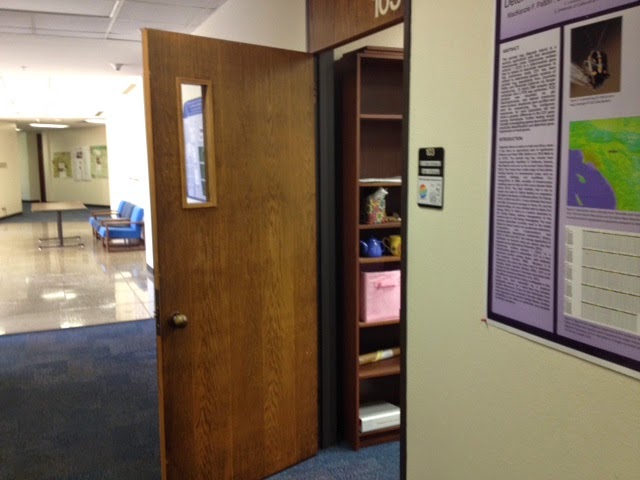
I've asked my colleagues, and I know they get far fewer questions like this. I sometimes wonder if students would interrupt my work so frequently if I were male, or 30 years older. But then I thought about how my office looks if you're walking down the hall:


That door is admittedly awkward, sticking out into the hallway. Then I realized how much my office looks like a pit fall trap, a commonly used method for capturing animals in the field:


As animals are wandering around, they hit the fence and walk along it until falling in the trap....just like what happens when someone is walking down the hallway, lost and confused. The location of my office is also partly to blame; I'm the first room inside the door to a confusing connection between buildings.

There aren't any easy solutions to alleviate my periodic irritation at having to answer random questions from strangers. I can open my door all the way to prevent the "drift fence" effect. I'm talking with campus facilities about putting up some signs to help direct folks to the appropriate building/department. I can remind students each time they interrupt me that they have the capacity to think ahead (i.e., look at the syllabus to find an instructor's office). 

Every once in awhile, though, I assist a student who is legitimately frustrated and I feel better for having alleviated their anxiety a little. Our university has a lots of first generation college students, and I empathize with folks who have little experience on which to base their interactions with folks working in higher education. As a result, there are a number of programs set up to help alleviate these issues and promote better students learning. It's easy for those of us from privileged backgrounds to view these efforts as hand-holding, but there is plenty of evidence on the efficacy of such programs in student retention and success.

If I challenge myself, I too admit the impact of a few individuals on my academic success, and how getting a simple question answered quickly makes a huge difference when juggling work, school, and family responsibilities. Besides...I wanted to work in academia because I like interacting with students! Ultimately, a handful of interruptions to my workday each week are a small price to pay for helping a student succeed.