When taking an exam in a large auditorium style lecture hall:
If you have a question about something on the exam, you must write it on paper, fold it into a paper airplane, and launch it successfully towards me. If your efforts are worthy, I will answer your question.
Ok, maybe not...but it would be amusing.
24 April 2013

22 April 2013
Just your normal azalea appreciation post.
The azalea bush planted outside my childhood home in Indiana was always in full bloom the week of my brother's birthday (in early May). The nice part about living further south is the earlier arrival of azaleas, as well as greater variety in floral morphology. I love bushes loaded with blossoms, which can almost completely obscure the leaves hiding beneath.
Shown below are three examples of lovely southern azaleas:
First, small white blossoms in full bloom today on Duke's campus.

Next, medium-sized light pink blossoms with really interesting dark pink nectar guides, also from Duke's campus,

Finally, some huge, shockingly pink blossoms I saw weeks ago while traveling for spring break. Leave it to New Orleans to have the showiest of flowers.

19 April 2013

How a traumatic week for the nation affects education.
I'm supposed to be leading a review session this morning for a class of ~400 students. Sure, I would expect only a small fraction of those enrolled to show up, but their final exam is next week and I imagine there will be at least a few questions about the material on macroevolution I assigned from Monday.
The problem right now is that, for the second time this week, a bomb threat has been called into the building where I teach. This morning's emergency text comes with speculation that this one isn't serious, but that the building is still being searched. Earlier this week, the fire alarm also went off twice right before class started. There's lots of construction in the building right now (not unusual for a college campus these days), so it's difficult to determine whether alarms and sounds are actually significant, or just a disruption.
I've spent almost all of my life either taking classes or working on college campuses. Disruptions from possible or imminent disaster occur periodically, especially in science buildings. Sometimes it's a careless student leaving "suspicious white powder" out on a lab bench rather than cleaning up. Sometimes it's a bunsen burner that sets off a fire alarm. Once it was a tank of flammable gas in a research lab that exploded.
This week, I've been reminded several times over that danger exists, either from malicious people or even just accidents. As I write, normal activity in Boston has slowed to a crawl as police seek out suspected perpetrators of violence. These types of things happen all over the world everyday, but we, as Americans, largely allow it to pass by without notice. This week, though, I can't ignore a twitter newsfeed full of minute-by-minute updates of casualties and announcements of the next catastrophic event. I'm on edge, and I'm vigilant. If something happens, I'm wondering how I'll react when a classroom full of students looks to me for guidance.
The last time there was a bomb threat it took a little over an hour to clear. I just received the text that the building is clear, and it took less than half hour. Looks like class can start in half an hour as planned. Frankly, though, if I were a student and received a text when I awoke that a bomb threat had been called into the building for one of my classes, I would probably go back to sleep. This pattern doesn't bode well for a campus heading into finals next week. I can post a video online detailing the questions I planned to cover in the review session, but that doesn't work so well for exams.
I was happy to hear a cricket chirping in the bathroom earlier, as it reminded me that, despite the chaos in various parts of life, the world still keeps doing its thing.
16 April 2013
Teaching with concept maps
One of the most challenging parts of the introductory biology (genetics and evolution) course I've been teaching this year is helping students understand how myriad biological phenomena and tools are related to each other. As a part of my macroevolution lesson on Monday, I provided students with a list of key words and instructed them to make a concept map. If you aren't familiar with these tools, I found this website to be a particularly useful introduction, although there are many others spanning a breadth of disciplines in which they may be used.
After students had a chance to try their hand at mapping these terms on their own, I communicated a few ideas of my own for connecting different thoughts. I used the open-source software VUE, which has functionality far beyond what I've shown here. Below is one of my attempts to unite disparate ideas in a web-like format:

Of course, there are as many ways to relate these concepts as there are scientists thinking about these concepts. Part of that complexity arises from how you choose to relate the words. The example above shows quite simple relationships. Below is another example, in which the relationships are diagrammed in a much richer manner (arrows and labels on connections, color coding/nesting of ideas, concepts mapping to multiple other nodes).

I'm not sure whether this exercise helped students. I'm going to provide a few examples of concept mapping schemes later this week as they prepare for their final. At the very least, some of the teaching assistants for the course found the activity interesting and useful. Minor victories!
15 April 2013
How does anything get fertilized around here, anyway??
 My obsession with pollen was reinvigorated today as I again momentarily became the weird woman photographing the ground on Duke's campus (other evidence of my geekery includes mushrooms and bursting heart).
The reason for my interest are those grass anthers wagging around in the breeze. It's not enough that the inflorescence sticks up above the plant. It's not even enough that the anthers are exerted so far out of the rest of the flower. This grass takes it even further by expanding the anther connectives (the piece of tissue connecting the two halves of the anther to each other and the rest of the filament).
With so much pollen floating around, wind pollinated species (like grasses) really need an advantage to get their gametes out there. Given how much pollen sticks to my phone as I walk outside, though, it's hard to imagine how pollen from a compatible plant ever manages to land on a receptive stigma that isn't already covered by pollen from other species.
12 April 2013
How much pollen is out there floating around, anyway?
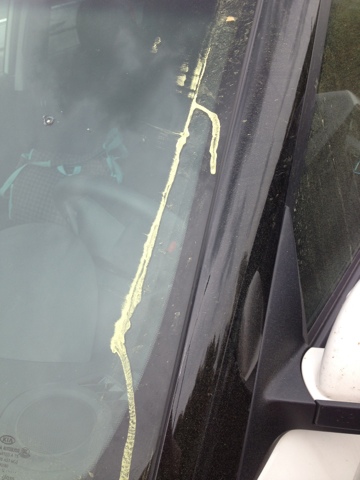 As a botanist, North Carolina resident and seasonal allergy sufferer, I experience a triple whammy of acute awareness when spring begins. This week marks the start of a curious natural phenomenon: the time of year when one puzzles over the greenish-yellow waft of particles covering everything, necessitating the use of windshield wipers to allow driving despite the onslaught of plant reproductive material (see right).
Indeed, North Carolina flora are spreading their gametes with a vengeance this time of year. Never before have I experienced such a visual demonstration of the prolific nature of pollen before, so I took the opportunity to perform a few "back of the envelope" calculations. How much pollen is actually being produced, anyway? I was pleased that forestry researchers have actually done enough of the hard work collecting empirical data about this topic to make discussion possible.
Loblolly pine (Pinus taeda) is the predominant species in most areas of the southeast and are widely planted for commercial timber. An adult tree (16 m) produces 81 grams of pollen a day for 2-4 weeks. Let's assume that means ~1 kg of pollen per tree per season (my sinuses are already saying "CRAP"). An estimated 3.3 million acres in North Carolina alone are planted stands of loblolly pine (although it's dominant on an estimated 29 million acres). I will assume density of planted stands is only 100 trees per acre. This is dramatically lowballing the number of trees, but this is allowing for a few considerations: 1) trees don't start producing pollen until they are 10-15 years old, and 2) stands of trees are sometimes planted at high density and later thinned to remove diseased/damaged/crowded trees.
So 3.3 million acres of trees, with 100 trees per acre, that's over 300 million trees. That means loblolly pines in North Carolina are producing 300 million kilograms of pollen each year. That's a level of scale my brain is having a tough time processing. The population of North Carolina is a little less than 10 million people. That means we each get 30 kg of loblolly pine pollen a year! Think of a large adult German shepherd. That's how much pollen. Per person.
But wait! It gets better! Because loblolly pines also occur in natural populations, and they're not the only plants producing pollen. They're not even the only pine trees producing pollen. And guess what? Pollen can travel over 41 kilometers in the air. And each gram of pollen contains over a million grains. I'm still having a tough time comprehending this level of scale, and am half hoping someone will say I've grossly miscalculated by an order of magnitude (the other scientist half of me, of course, wants to be right). Well, now that I've thoroughly discouraged myself, I think I'll get back to work.
Literature referenced:
Baker, James B. and O. Gordon Langdon. Loblolly pine. Silvics of North America. Agriculture Handbook 654. USDA Forest Service.
Biofuels Center of North Carolina. 2011. Loblolly Pine Trees. Biofuels Wiki.
Williams, Claire G. 2009. Conifer Reproductive Biology. Springer: New York. 169 pages.
Williams, Claire G. 2010. Long-distance pollen still germinates after mess-scale dispersal. American Journal of Botany 97(5): 846-855. doi: 10.3732/ajb.0900255 (research supported by NESCent!)
Subscribe to:
Posts (Atom)