Showing posts with label botany. Show all posts

28 May 2014

Even among big trees, I stare at the ground.

I flew out to California a few weeks back to meet my sister and mom for a road trip up to Reno for my brother's graduation. First off, congrats to Dr. Thomas J. Hertweck for completing his PhD in English (Literature and Environment) from the University of Nevada, Reno! I was pleased to be able to meet some of the other fantastic folks in his department, and am hoping to be able to collaborate on some Hertweck & Hertweck publications in the future. Although Tom professes to be "traditional" and eschews official obligations to social media, I know he still frequently lurks the interwebs…so good job, big bro.

Sequoia sempervirens, or redwood trees
While out west, I convinced my family to traipse around a few parks so I could fit in a little botanizing. The highlight was Calaveras Big Tree State Park. You're probably not surprised that there were some pretty big trees. There is only one species of sequoia (a commonly used name in the vernacular), which belongs to the genus Sequoia, and is also known as coastal redwood or just redwood. Redwoods belong to the sequoia subfamily of the cypress family. There are lots of other species of cypress, but redwoods are the only sequoias…other related species are long extinct.
Glad to get the tree taxonomy off my chest! Turns out this trip was a good way to torment educate my family about botany.


Come to find out, even when I'm walking in a forest with some of the tallest trees around, I still tend to look down. Sometimes it's because a downward gaze lets you appreciate the size of these trees. 
Mostly, though, I'm looking nearer towards the ground because I get distracted by flowers. Sometimes they're pretty similar to the plants I see back east. I've placed some tentative species names with the pictures below, but it's really half-assed botanizing at best (hey, I was on vacation).

Dicentra formosa, Pacific bleeding heart. Bleeding hearts are found all over the place, but this local species had nice pink flowers (I'm a sucker for them)
Trillium chloropetalum, giant wakerobin (indeed, it was quite large, the size of a dinner plate!)

Smilacina stellata, false Solomon's seal (widespread, the same one I see on the east coast!)

I'll admit it…I really don't care about identifying trees from Rosaceae.

Corallorhiza striata, an orchid (!)
And sometimes I come across really cool saprophytic plants! Saprophtyes are plants which obtain their nutrients from dead and decaying material on a forest floor. Here's a pretty nice explanation of them (with more gratuitous plant pics) from a carnivorous plant website (because weird plants gotta stick together, ya know?). These types of plants are particularly near and dear to my heart because I talk about them in a manuscript I'm currently revising for publication. Really cool evolutionary stuff!

Sarcodes sanguinea, snow plant, a saprophyte from the heath/blueberry family


I'm not gonna lie. I always feel pretty special when I see a saprophytic plant in the wild, and I think it's mostly just because they're so weird. Not green? Not a problem! Still a plant. I'm sure I'll wax philosophical about these and other topics again in the near future.

12 April 2013

How much pollen is out there floating around, anyway?


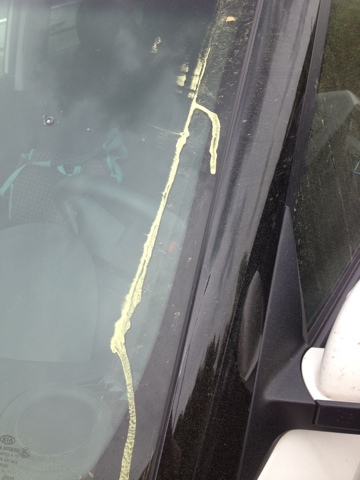
As a botanist, North Carolina resident and seasonal allergy sufferer, I experience a triple whammy of acute awareness when spring begins. This week marks the start of a curious natural phenomenon: the time of year when one puzzles over the greenish-yellow waft of particles covering everything, necessitating the use of windshield wipers to allow driving despite the onslaught of plant reproductive material (see right).

Indeed, North Carolina flora are spreading their gametes with a vengeance this time of year. Never before have I experienced such a visual demonstration of the prolific nature of pollen before, so I took the opportunity to perform a few "back of the envelope" calculations. How much pollen is actually being produced, anyway? I was pleased that forestry researchers have actually done enough of the hard work collecting empirical data about this topic to make discussion possible.

Loblolly pine (Pinus taeda) is the predominant species in most areas of the southeast and are widely planted for commercial timber. An adult tree (16 m) produces 81 grams of pollen a day for 2-4 weeks. Let's assume that means ~1 kg of pollen per tree per season (my sinuses are already saying "CRAP"). An estimated 3.3 million acres in North Carolina alone are planted stands of loblolly pine (although it's dominant on an estimated 29 million acres). I will assume density of planted stands is only 100 trees per acre. This is dramatically lowballing the number of trees, but this is allowing for a few considerations: 1) trees don't start producing pollen until they are 10-15 years old, and 2) stands of trees are sometimes planted at high density and later thinned to remove diseased/damaged/crowded trees.

So 3.3 million acres of trees, with 100 trees per acre, that's over 300 million trees. That means loblolly pines in North Carolina are producing 300 million kilograms of pollen each year. That's a level of scale my brain is having a tough time processing. The population of North Carolina is a little less than 10 million people. That means we each get 30 kg of loblolly pine pollen a year! Think of a large adult German shepherd. That's how much pollen. Per person.

But wait! It gets better! Because loblolly pines also occur in natural populations, and they're not the only plants producing pollen. They're not even the only pine trees producing pollen. And guess what? Pollen can travel over 41 kilometers in the air. And each gram of pollen contains over a million grains. I'm still having a tough time comprehending this level of scale, and am half hoping someone will say I've grossly miscalculated by an order of magnitude (the other scientist half of me, of course, wants to be right). Well, now that I've thoroughly discouraged myself, I think I'll get back to work.

Literature referenced:
Baker, James B. and O. Gordon Langdon. Loblolly pine. Silvics of North America. Agriculture Handbook 654. USDA Forest Service.

Biofuels Center of North Carolina. 2011. Loblolly Pine Trees. Biofuels Wiki.

Williams, Claire G. 2009. Conifer Reproductive Biology. Springer: New York. 169 pages.

Williams, Claire G. 2010. Long-distance pollen still germinates after mess-scale dispersal. American Journal of Botany 97(5): 846-855. doi: 10.3732/ajb.0900255 (research supported by NESCent!)


17 October 2012

How to make snapdragons talk.

While walking along the street in Seattle, I came across some snapdragons. Look how plump and lovely their petals appear! I love plants. I also love interactive plants, and anthropomorphizing floral features by turning them into puppets. Therefore, I present: making snapdragons talk. Snapdragons are members of the plant family Scrophulariaceae and genus Antirrhinum. Their petals are modified and fused into a bilaterally symmetric structures characterized as bilabiate corollas. What's nice about that, you ask? Well, "bilabiate" means "two-lipped," implying that these flowers are basically begging to talk! 
So here's how you do it: find a Goldilocks flower (one that isn't too young or too old). Grasp the sides between your thumb and forefinger, then squeeze so that the top and bottom "lips" pop open like a mouth. You might need to try a few flowers, since the structural integrity of the bloom changes as it ages (there's some cool science about senescence involved here). I like to also make sounds for them, in proper puppet-style. My snapdragons always say things like, "Muah muah muaaaaaah." Sometimes they even sound like robots!
An additional method for making snapdragons talk involves wrangling a fairy with magic. I haven't quite mastered the technique yet (in truth, I've never even tried), and there is also no sure way to tell what the flowers will say. Therefore, I'm only presenting my "manual method" here. 

Perhaps I should stop now while I'm still claiming this is a blog that talks about science.

27 September 2012

Bursting heart.

I spotted a lovely specimen of Euonymous americanus, or strawberry bush, alongside a path on Duke's campus earlier this week.

In proper botanical romanticism style, I tend to prefer the whimsical common name of bursting heart.

I'm primarily a monocot girl, but these are the prettiest plant displays right now (at least until the naked ladies get going soon...I've seen a few already!).

20 July 2012

Old books and plant porn.

I spent a lot of time in graduate school digging through the depths of the internet and library archives for species descriptions of members of the monocotolydenous plant family Commelinaceae. I focused on several genera in this family as a part of my dissertation work, so I aimed to become an expert in taxonomy. I stumbled across a few articles of note in Curtis' Botanical Magazine, so I ordered the relevant issues from the library's book depository.

The day I went to the library to look at said books, I was surprised with a different protocol than with previous books I'd studied. My normal procedure was to look through the books for my articles, decide whether it was useful, and head to the print center to make copies. This time, though, I had to be escorted to the print center and supervised while I made copies. I understood the level of protection afforded this journal once I opened the books--each volume included descriptions of plant species along with beautiful, full color drawings. Quite amusing to me were the drawings which appeared on glossy, fold-out pages like pin-up models. Veritable plant porn!

I recently learned several volumes of Curtis' Botanical Magazine are now available on Project Gutenberg. I'm pleased to see these works being electronically archived and easy to access. I've included here the illustration for one of my study organisms, Tradescantia virginiana, from Volume 3.