Showing posts with label evolution. Show all posts

04 December 2014

A catalysis meeting on long term experimental evolution.

Travel makes it easy to let blog posts slip away without being fully formed, written, and posted. Now that the semester is winding down, I'm going to try and follow through with writing the backlog of posts that have been piling up from my adventures over the last few weeks. Today's report is about the first part of my trip back to NESCent and North Carolina the week before Thanksgiving.

The catalysis meeting I attended on long term experimental evolution (you can read a little more about the meeting and participants here) was not only fantastic but also the last NESCent will host (more on this in a later post). Although the topic is outside of my main research interests, I answered the solicitation to participate in this meeting because of some research I've been doing with Joe Graves, Michael Rose and colleagues on experimentally evolved Drosophila populations. Moreover, there seem to be some really interesting opportunities to explore robustness of analytical methods using experimental evolution data, which is of particular interest to me.

Here are the things I found compelling about this meeting:
  1. Meeting organizers set the tone. Rob Lanfear, the main organizer, put together a fantastic webpage and started a Mendeley group so we could share literature beforehand.
  2. The participants were diverse. Forty four percent of attendees were female. There were graduate students, postdocs, early career scientists, and senior researchers present, and folks came from all over the world. Model systems included microbes, invertebrates, fish and trees. 
  3. We capitalized on the group's diversity. As an early career scientist, I was pleased to develop relationships with a number of other folks starting faculty jobs at similar institutions. As a group, I was gratified to hear well-respected, senior scientists describing junior scientists' research as "brilliant." There were multiple types of interactions incorporated into the meetings such that folks who were hesitant to speak in full-group discussions could still contribute ideas. In short, this meeting exhibited many aspects of scientific discourse that are overlooked, but which I value deeply.
  4. Attendees were invested in the meeting itself. Part of the meeting was structured (or perhaps more accurately, unstructured) as an "unconference," with participants determining topics for talks and group discussions on the fly. Despite this free-form format, folks in this group were very interested in talking about broader research ideas, rather than pushing their own agendas.
I left the meeting with a much wider and deeper understanding of experimental evolution as an active field of research, as well as a better grasp on different ways of thinking about the process of science and its limitations. I was also grateful to participate in one last meeting of this type at NESCent...stay tuned for my next post to hear more about that!

27 June 2014

Con drop and lessons learned from Evolution/iEvoBio 2014

I'm in the midst of processing the aftermath of seven very full days of scientific conference. After almost twelve hours of sleep, I'm feeling a bit of a science hangover.  It occurs to me that this post-conference experience is not unprecedented or unfamiliar. Con drop is pretty well documented by other attendees of a variety of conferences and conventions (look here and here for a few examples), and is generally related to the let-down accompanying the return to real life following submersion in a large group of like-minded people. I don't recall seeing much discussion about post-science con drop, but it makes sense. Especially this year: I was on my home turf, seeing lots of folks I already knew and meeting lots of new people, all of us exuberant on the fumes of scientific progress. In the days following Evolution, I found myself relieved at the relaxation of my scheduled obligations but simultaneously bereft. As I slowly return to "real life," I decided to note a few of the big take-home lessons from Evolution 2014 and iEvoBio. A few other folks have written similar posts (I particularly like Rob's lessons and Jeremy Yoder's tweet synopsis).

First, my time limit for conference science-ing is six hours. I do a passable job of stifling my introverted nature for a time, but it means I need to pace myself. If I do a full morning of talks and lunch meeting, I'll have to take a break mid-afternoon and spend some time along. I'm really glad I have a tangible, quantifiable amount of time that seems to be consistently manageable for me…makes planning easier next time!

Second, I participated in two informal lunch-time gatherings: one tweet-up and one LGBTQ meeting. We tried two different models for these. For the first, we met at the registration desk and wandered elsewhere to find lunch. For the second, we had a lunchtime venue planned. Neither seemed satisfactory, as finding a place for 15+ people to eat is difficult, regardless of the amount of planning involved. I'm thinking about better ways to achieve future meetings, such as contacting conference organizers to have a room assigned. I don't know if I want to manage a formal discussion like the one I attended for AWIS at Evolution, but I like the idea of providing a venue to facilitate interactions between groups of likeminded people.

Of course, there are plenty of other things I'd like to break down in more detail, but fomenting ideas about these main topics seems sufficient navel-gazing for now.

18 June 2014

Planning for Evolution 2014

Now that I've spent some serious time going through the Evolution 2014 program and trying to plan my daily schedule, I find I'm completely exhausted and ready for a mental break. I'm not even sure why I bothered putting together a list of fun bars in downtown Raleigh, since I can't imagine any of us being awake long enough to partake of any area establishments.

Top items on my agenda for this meeting include:

  1. Phylogenomics Symposium and Software School (Thursday and Friday), because learning new analytical methods is FUN!
  2. Chairing a session on Life History Evolution (Saturday morning, 8:15-10, Rm 303), during which my talk will take place (Jumping genes and life history: De novo transposable element insertions respond to selection for accelerated and delayed development times, 9:30 am). I'll have my slides up on Slideshare that morning.
  3. I'm mentoring two students as a part of the Undergraduate Diversity program (co-sponsored by NESCent).
  4. A few short meetings of various levels of formality, including one discussing implicit bias, another for LGBTQ folks, and some from the NSF.
  5. NESCent's Evolution Film Festival!
  6. Attending the usual set of poster sessions, keynote addresses, lightning talks, receptions, etc.
  7. iEvoBio, to round out my informatics geekery.
I realized today that I've committed myself to seven straight days of evolution thinking and learning. That's A LOT of brain juice. I'm going to be focusing a lot on remembering my list of ways to strategize and manage these huge, marathon-style conferences. I've tried to communicate to my partner the amount of time and energy attending these conferences requires. The conversation went something like this: 
Me: I'll be busy doing conference stuff from Thursday to Wednesday.
Him: OK! Want me to make you breakfast and plan dinners?
Me: Um, I have events scheduled from eight to ten most days. I can grab food for myself, but thank you.
Him: Ten…at night? 
When he said it like that, I started to wonder if it was a little crazy, too. Ah, professional meetings….

11 June 2014

Want someplace to go at Evolution 2014 after regularly scheduled events? Check out my map of downtown Raleigh!

After attending a few large professional conferences, you start to realize that some of the best ideas happen after the scheduled events of the meeting, when folks head off to restaurants and bars to socialize into the wee hours of the morning. I also know how challenging it can be to find someplace suitable when you're just a visitor in a city. The Evolution 2014 website does a great job of highlighting  local restaurants for during the day, but I thought it would be nice to have a reference for late-night socializing (which may or may not include drinking some of the wonderful local beer North Carolina has to offer).

Luckily, I've lived in the RDU area long enough to be able to recommend a few places. I compiled these locations in a handy google map (color-coded red), including the location of the conference center (black), conference housing (yellow), and NESCent/area universities (for reference, in green). I put a screenshot below, but click on the link and you can select each marker for the website (hours, events, etc) as well as a way to estimate distance from wherever you are. I included a variety of establishments: bars with good food, dive bars, LGBTQ-friendly places, and even a basement whiskey bar. If you know the area and want someplace added, drop me a note! Finally, and I hope this is obvious: this resource is in no way endorsed by the conference or NESCent…it's just my attempt to help make your trip a little more fun and relaxing.

Downtown Raleigh after hours

20 June 2013

A prelude to Evolution 2013

I'm heading to Snowbird, Utah tomorrow for Evolution 2013. I've been attending these meetings for over a decade now, and always look forward to the breadth of science discussed. Here are the activities with which I'm involved this year:


  1. My talk is on Saturday, 4:15 pm in Cotton D/Snowbird Center: "Genome-wide transposable element insertion frequencies change with selection for accelerated development." It's the first time I'm not talking about plants at an Evolution meeting! I'll be talking about a pretty sweet side project (collaboration with other NESCent and UC Irvine folks) about population genomics of TEs from an experimental evolution study in Drosophila.
  2. My poster is on Sunday, number P240003: "Transposable element proliferation and genome size evolution in Asparagales." This is my main NESCent project and the subject of my recent paper from Genome.
  3. I'm co-hosting NESCent's Evolution Film Festival on Sunday night in the Ballroom. I've watched the entries and am impressed by the variety of topics and approaches.
  4. I'm participating as a mentor for the Undergraduate Diversity Program, and am looking forward to meeting with budding young scientists.
  5. I'll be hanging out at the NESCent booth at various times during the conference.
  6. Looking forward to attending iEvoBio on Tuesday and Wednesday!
Definitely a busy schedule, but that's the way I like it! In terms of continuing activities at the conference:
  1. I'll likely be knitting during talks (the hows and whys are worthy of another post altogether, but I assure you I'm still paying attention).
  2. I'll be typing furiously on my laptop and/or iPhone by tweeting (as @k8hert, using #evol2013 for the main conference and likely another for iEvoBio) and taking notes using Evernote.
  3. I'll be following my PhD advisor Chris Pires' advice for conferences: "Meet someone older than you, someone younger than you, and watch a talk that changes how you think about things."
See you at the conference!

16 April 2013

Teaching with concept maps

One of the most challenging parts of the introductory biology (genetics and evolution) course I've been teaching this year is helping students understand how myriad biological phenomena and tools are related to each other. As a part of my macroevolution lesson on Monday, I provided students with a list of key words and instructed them to make a concept map. If you aren't familiar with these tools, I found this website to be a particularly useful introduction, although there are many others spanning a breadth of disciplines in which they may be used. 

After students had a chance to try their hand at mapping these terms on their own, I communicated a few ideas of my own for connecting different thoughts. I used the open-source software VUE, which has functionality far beyond what I've shown here. Below is one of my attempts to unite disparate ideas in a web-like format:
Of course, there are as many ways to relate these concepts as there are scientists thinking about these concepts. Part of that complexity arises from how you choose to relate the words. The example above shows quite simple relationships. Below is another example, in which the relationships are diagrammed in a much richer manner (arrows and labels on connections, color coding/nesting of ideas, concepts mapping to multiple other nodes). 

Is it perfect? Nope. Is it comprehensive? Certainly not. I've gradually learned over the course of my educational and professional career that my brain naturally builds connections between disparate content knowledge. Whereas other folks find concept mapping challenging because of misunderstanding the relationships between nodes, I find them frustrating because of an inability to exhaustively explore relationships. Concept maps are a balance between conveying information and rendering connections useless through convolution.

I'm not sure whether this exercise helped students. I'm going to provide a few examples of concept mapping schemes later this week as they prepare for their final. At the very least, some of the teaching assistants for the course found the activity interesting and useful. Minor victories!

19 September 2012

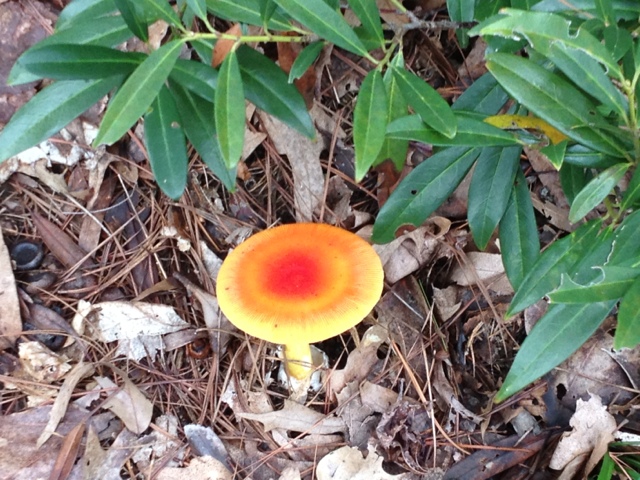
I'd often rather stop and photograph a mushroom than stop to smell roses.


Granted, it's easier to find mushrooms than blooming roses during a rainy North Carolina September, but the colors of this particular specimen would give any flower a run for its money. I came across this lovely mushroom while walking across Duke's campus this morning and could resist taking a moment to marvel over its color and form. What use is being a biologist, after all, if I can't indulge in a bit of wonder and curiosity at the natural world?
I've talked with a couple of folks lately about how a mindset accustomed to biological research intersects with the rest of the world. I know quite a few biologists who are also artists, either through photography, painting, or music. My chosen medium is fiber (like wool yarn to felt or knit), and my research constantly catalyzes new projects and offshoots of creativity. 
While on retreat last week, I was also reminded of another common interest of biologists--history. I took the picture to the right in the main gathering hall at the biological station where we met. The botanical and owl wood carvings were fantastic, but the piano(-ish) instrument in the middle was just as interesting. More specifically, the 50 year old music books on the stand were quite compelling. I was not the only one to take note of these objects. Upon further contemplation, it comes as no surprise that evolutionary biologists would be interested in historical stories and artifacts...after all, both areas of study require an appreciation of time.


08 September 2012

Data visualization


I've been thinking lots lately about how we visualize data in biological research. As a student of both communication and science, I find the interplay between the two fields to be especially compelling. This interest was reinvigorated last spring by some meetings with a visiting NESCent scholar, Tyler Curtain, who introduced me to some of the preeminent and current literature on the field. Since then, I've noticed the theme popping up repeatedly in my interactions with colleagues. Folks pop in to my office to ask for advice on figures, and some NESCent-associated projects like Open Tree of Life are particularly interested in advancing visualization abilities for evolutionary biology.

As a result of this convergence of events, I jumped at the chance to take a short workshop on data visualization offered by Duke Libraries Data and GIS Services. I was struck by the breadth of options available for representing data visually, and began thinking a bit about how different figures in evolutionary biology are from other fields. I talked a bit with Angela Zoss, the instructor of the course, who concurred that biological disciplines tend to lag behind other sciences in adopting more effective methods of visualizing data (I would extend that claim and imply that sciences in general lag behind other fields of study as well).

Let's face it, folks. Figures representing biological data are notoriously problematic to not only build, but interpret. Dendrograms (which in the data visualization world include many types of tree structures) are very complicated in evolutionary biology, and our tendency is to cram as much information as possible into each figure. A single diagram may include tree topology, branch lengths/divergence times, taxon names (tree tips AND higher taxonomic groupings), color coding for one or more traits, etc. Additionally, I've long thought that effective visualizations for genomics research, especially in the comparative realm, are notoriously convoluted and difficult to understand.

Why are our figures so complicated? I think it's because biology as a science inherently includes many different variables, each of which includes sometimes large margins for error. As scientists, we want to tell our research narrative in as non-biased a manner as possible, which means including (visually) as much data as possible. This impulse is compounded by a push to streamline figures for publications, which is further complicated by lack of availability of color, space, and resolution.

But let's face it. We're never telling an unbiased story with our figures. We make decisions about inclusion of data in a study and methods of analysis even before we get to the publication stage, and cramming as much summary information as possible into a figure doesn't represent those biases. What is the goal of a figure or representation of biological data? It should be interpretable by an audience, which in journals means scientific peers. When visualizations become so specialized that only a handful of people in a field can understand them, we're working counter to the purpose of the visualization. It's not doing its job.

I advocate striking a balance between the goals of the two paragraphs above. Tell a clear story with the data, but include enough information for the audience to understand associated variance and error. As a result, I'm planning a open discussion at NESCent with folks from our informatics and science groups, in addition to folks who work on data visualization, to see how we can improve our methods of building figures.

Possible topics for contemplation include (but aren't limited to) the following:

  • tree visualization
  • deep time
  • visualizing error
  • taxonomic levels
  • trait mapping

29 August 2012

And so it begins.

My silence here over the last few weeks is attributed to a common source of consternation among academics: the beginning of the semester. I've taken on a new role for work this academic year. For the first time, NESCent has teamed up with Duke Biology to sponsor a postdoctoral position. The responsibilities are half-time teaching and half-time research (regular postdocs at NESCent spend are full-time researchers on their independently directed projects). I was fortunate enough to apply for and obtain this position, and August 1 marked the transition to these new responsibilities. Thus, I've spent time over the last few weeks preparing for the start of classes this last Monday.

Several other postdocs in my cohort expressed disbelief that I would choose to sacrifice a portion of my research time over the next year. NESCent is an idyllic place for postdocs. We choose our own research activities and have a great deal of freedom in balancing projects. I also have quite a bit of teaching experience. What was my impetus for pursuing teaching, then?

Well, I really like teaching. I'm also assisting in teaching a class I find very compelling for both intellectual and research purposes. There are two introductory biology classes here at Duke: cell/molecular and ecology/genetics. The latter class, which is a spot-on match for my own research pursuits, is the class with which I am involved. I'm teaching a lab section and helping with curriculum development for the lab and lecture. There are several facets of this experience I'm hoping will give me some perspective as I start applying for faculty positions, including interacting with a different demographic of student than I am accustomed to teaching, observing a variety of lecturers, and integrating on-line class components. That's even before I start helping modify any course content! I expect to teach genetics and evolution courses in the future, so I'm totally jazzed about thinking about setting up such courses right now.

Part of my job this year is observing class lectures three times a week. I've both taken and taught classes that have covered similar material in the past. It would be easy to settle into a mindless stupor instead of remaining engaged. Instead, I'm taking the opportunity to think about broad concepts of evolution and teaching, and think about connections in my contextual framework of scientific knowledge. It amuses me that I keep getting mini-epiphanies throughout the course of these lectures, reinforcing my belief that thinking about education is well worth my time.

18 July 2012

Choice in biological systems

While discussing my research with my committee as a graduate student, I made a reference to plants "seeking out more suitable habitat." A faculty member asked if said plants sprouted legs and walked to a different area before plunking down and setting roots. I was able to resolve this semantic issue because the plants in question are clonal, so they can literally send out a rhizome toward a new area. Her point was well taken, though, and issues related to verbiage in biology continue to intrigue me.

There are common issues in molecular biology wherein enzymes or other portions of biochemical pathways are anthropomorphized in language. These issues arise most often when interactions between molecules are communicated like we would talk about human behavior.

A related but slightly different issue arose in a NESCent seminar today. A discussion about sex allocation included some references to human sex ratios at birth. The ratio of males to females are thought to be altered by a variety of factors, including acute or chronic stress. Someone argued that in certain situations, females may "choose" to alter the sex of their offspring to better suit the demographics of the new environment (i.e., more males to replace those lost in battle).

We're all scientists here. We know that women don't consciously choose to have male or female babies, but someone took issue with the previously mentioned hypothesis because of the failure of that mechanism. In terms of evolutionary time, though, it makes sense. The tendency to produce male offspring when an overabundance of females comprise a population is potentially heritable, and would definitely be positively selected, especially if the male population is low.

I don't know how plausible the latter hypothesis is, or whether selection could mechanistically support it. The point is that "choice" in this instance refers to a trait over which selection occurs throughout evolutionary time. The woman's genetically encoded physiology as shaped by evolutionary time is actually doing the choosing. Such is the plight of evolution research, where misinterpretations of even seemingly innocuous words can yield misunderstandings...even among scientists.

22 February 2011

All about R

I'm an evolutionary biologist. Right now I happen to work on genomes, and I really like the way the world looks from this corner of biology. These days, though, evolutionary genomics involves lots and lots of bioinformatics and computation, so I'm gradually honing my skills in Terminal, on servers, etc (I'm a Mac girl).

My latest obsession is R, which happens to have a ton of awesome packages for evolutionary analysis. I was lucky enough to be featured on my friends' blog, Teaching My Wife R. I'm Princess Trad! I'm almost useful! I'm learning AND teaching, hooray! If you're even more of a glutton for punishment, you can also check out some of the cutting edge development in evolutionary analysis in R.