15 April 2013

How does anything get fertilized around here, anyway??

My obsession with pollen was reinvigorated today as I again momentarily became the weird woman photographing the ground on Duke's campus (other evidence of my geekery includes mushrooms and bursting heart).

The reason for my interest are those grass anthers wagging around in the breeze. It's not enough that the inflorescence sticks up above the plant. It's not even enough that the anthers are exerted so far out of the rest of the flower. This grass takes it even further by expanding the anther connectives (the piece of tissue connecting the two halves of the anther to each other and the rest of the filament).

With so much pollen floating around, wind pollinated species (like grasses) really need an advantage to get their gametes out there. Given how much pollen sticks to my phone as I walk outside, though, it's hard to imagine how pollen from a compatible plant ever manages to land on a receptive stigma that isn't already covered by pollen from other species.

12 April 2013

How much pollen is out there floating around, anyway?


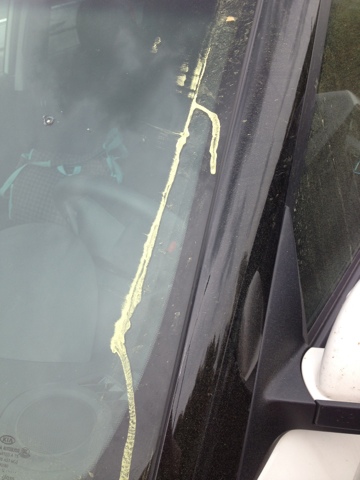
As a botanist, North Carolina resident and seasonal allergy sufferer, I experience a triple whammy of acute awareness when spring begins. This week marks the start of a curious natural phenomenon: the time of year when one puzzles over the greenish-yellow waft of particles covering everything, necessitating the use of windshield wipers to allow driving despite the onslaught of plant reproductive material (see right).

Indeed, North Carolina flora are spreading their gametes with a vengeance this time of year. Never before have I experienced such a visual demonstration of the prolific nature of pollen before, so I took the opportunity to perform a few "back of the envelope" calculations. How much pollen is actually being produced, anyway? I was pleased that forestry researchers have actually done enough of the hard work collecting empirical data about this topic to make discussion possible.

Loblolly pine (Pinus taeda) is the predominant species in most areas of the southeast and are widely planted for commercial timber. An adult tree (16 m) produces 81 grams of pollen a day for 2-4 weeks. Let's assume that means ~1 kg of pollen per tree per season (my sinuses are already saying "CRAP"). An estimated 3.3 million acres in North Carolina alone are planted stands of loblolly pine (although it's dominant on an estimated 29 million acres). I will assume density of planted stands is only 100 trees per acre. This is dramatically lowballing the number of trees, but this is allowing for a few considerations: 1) trees don't start producing pollen until they are 10-15 years old, and 2) stands of trees are sometimes planted at high density and later thinned to remove diseased/damaged/crowded trees.

So 3.3 million acres of trees, with 100 trees per acre, that's over 300 million trees. That means loblolly pines in North Carolina are producing 300 million kilograms of pollen each year. That's a level of scale my brain is having a tough time processing. The population of North Carolina is a little less than 10 million people. That means we each get 30 kg of loblolly pine pollen a year! Think of a large adult German shepherd. That's how much pollen. Per person.

But wait! It gets better! Because loblolly pines also occur in natural populations, and they're not the only plants producing pollen. They're not even the only pine trees producing pollen. And guess what? Pollen can travel over 41 kilometers in the air. And each gram of pollen contains over a million grains. I'm still having a tough time comprehending this level of scale, and am half hoping someone will say I've grossly miscalculated by an order of magnitude (the other scientist half of me, of course, wants to be right). Well, now that I've thoroughly discouraged myself, I think I'll get back to work.

Literature referenced:
Baker, James B. and O. Gordon Langdon. Loblolly pine. Silvics of North America. Agriculture Handbook 654. USDA Forest Service.

Biofuels Center of North Carolina. 2011. Loblolly Pine Trees. Biofuels Wiki.

Williams, Claire G. 2009. Conifer Reproductive Biology. Springer: New York. 169 pages.

Williams, Claire G. 2010. Long-distance pollen still germinates after mess-scale dispersal. American Journal of Botany 97(5): 846-855. doi: 10.3732/ajb.0900255 (research supported by NESCent!)


10 April 2013

Discussion role call!

I spent prolific amounts of time as a student participating in competitive speech and debate. One of the categories of high school speech in Indiana was Discussion. This aptly named group placed students in a room together where they were expected to talk about a pre-assigned issue. Such a set-up, however, begs the question: how do you rank participants, given it is a competitive event? Even more fundamentally: what makes someone better than another at talking about stuff?

Such was my first introduction to the importance of the variety of roles in a group discussion setting. Here's a description of different types of discussion roles from a non-profit group; I selected this particular link over myriad others because of the breakdown into "task" and "maintenance" roles. These same principles are applied in many contexts, including education. Often, teaching resources recommend students are assigned a single role for a class period or task. In the afore mentioned competitive sense, a successful participant was one who effectively filled multiple roles during the course of the conversation.

This digression to memories from high school is brought to you by reflections on the catalysis meeting in which I participated a few weeks back. As previously discussed, catalysis meetings present interesting dynamics. Scientists at different career stages are better suited to some types of discussion roles. Everyone can make contributions, albeit in different ways. In a broader sense, I find myself tallying my own (and others') fulfillment of these roles in other settings, such as during journal club (we meet once a week here at NESCent to talk about a recently published scientific article). My observations are based partly in a desire to study communication, but mostly in an effort to enrich my interactions with professional colleagues and expand my thinking.

It's gratifying the multitude of time I spent competing in speech and debate continue to reap benefits.

02 April 2013

Why I hate working in my office.

I rolled out of bed early this morning and popped open my laptop to check how the intertubes had managed without me overnight. I played around on twitter, facebook and other usual sites, then looked at my agenda for the day. I started a new script running on the server after finding my previous job had successfully completed, and then finished writing a research proposal.

Then I looked at the clock. Yowza! I was going to be late to work! Wait a minute...I was working, quite efficiently, and I didn't really have a time I was supposed to be at work. I narrowed my eyes at my brain, suspicious of its instincts. As a NESCent postdoc, all of my work is computational. That means I'm very mobile and can work anywhere. Despite that fact, I'm compelled to be in my office as much as possible, in order to interact with other scientists and be part of the NESCent community. Sounds great in principle, especially since I have a nice big monitor on my desk that makes figure revisions and other tasks so much easier. In practice, however, I find spending time in my office to be increasingly difficult.

First, I spend lots of time across campus because of teaching responsibilities. Shuttling back and forth between offices takes lots of time, and sometimes that time is better spent actually getting formal science deliverables accomplished, even if it means being away from NESCent. A side note to this point is that I expend lots of social energy interacting with and motivating students. As an introvert, exhausting this energy inhibits my ability to effectively manage my shared office.

Second, long stretches of time in my office end up being quite uncomfortable. In addition migraines, which I've already discussed here, I've been dealing this semester with some other health issues that make it difficult to work for long periods of time. I need to take frequent breaks. I want to nap. Both of those things are easier to do at home. To top it all off, there's construction behind our building right now. I'm becoming increasingly convinced that being forced to listen to the automated beeping of a truck backing up should be officially classified as a form of torture.

What's the point of me writing this, except to complain? I acknowledge that I have it easy compared to many other people. My schedule is flexible, and I won't be fired because I don't spend enough time at the office. I'm still productive, and I'm still happy with my work. I may want to be a more active member of the NESCent community, but I also acknowledge that it's a goal which requires a delicate balancing act at times. Most importantly, I've made the decision to take care of myself. I've spent six hours sitting at my desk today. I consider it a major accomplishment that I do not have a full-blown migraine.

How did I do it? I've learned to set a timer for 30-45 minutes, and to force myself to take a break when the timer goes off. I keep knitting at my desk, and I'll bring in a novel for leisure reading later this week. These are management strategies, not procrastination strategies. I wish I could work for hours at a time, uninterrupted, like I could ten or even five years ago. I worry that my peers think I'm lazy. I feel lazy in comparison to my old work habits, especially when I saunter into work at 10:30 am because I was working so well at home.

I remember peers in grad school who left a laptop open and a labcoat hung on their chair when they went home, so it looked like they were still working somewhere else in the building. I suppose the moral of the story is that, in science, you can never do "enough" work. There's always another manuscript/grant to write or experiment to run. I could destroy my mind and body by trying to maximize time spent working, or I could maximize my effectiveness at work. The latter strategy means fewer hours spent, but more product per unit time. As a bonus, I save my sanity. I think I'll stick with it.

26 March 2013

Catalyzing landscape genomics.

Earlier this month, I participated in a catalysis meeting at NESCent on landscape genomics. There is a common theme for each catalysis meeting. Sometimes that uniting principle is a historic area of research with multitudes of literature that could benefit from synthesis and identification of uniting principles. Sometimes the theme is an emerging area of science for which new questions are being elucidated. The landscape genomics catalysis meeting was interesting in that it addressed several major themes in evolutionary biology (population genetics, signatures of selection, comparative genomics) and was looking for ways to unite them theoretically and statistically into predictive methods. I was initially curious why the organizers chose to invite me, but quickly came realize how aligned the themes of the meeting are with my own research interests. Here are a few impressions from the time I spent sharing my thoughts with other scientists.

First, catalysis meetings are an interesting conglomeration of scientists. The goal of such meetings are to throw 25-30 scientists from different research foci and at various stages in their careers into a room together.  No one person was an expert on landscape genomics. There were experts in landscape ecology, comparative genomics and statistics, and we worked together to devise common projects and goals. The beautiful part of synthesis is that contributions from various participants are required to achieve the goals of the meeting. There are many people contributing, and everyone learns something. As a recent article from NESCentians points out, this is a fertile ground for incubating new collaborations, projects, and ideas.

Second, an aggregate of such brains allows new insight into how science works. Well, that's certainly a vague statement. At this meeting in particular, several of us were struck by the differences in how genomics and ecology view data. The former tends to throw out data left and right, paring down sequences and levels of variation so the remaining data can be described more easily. Ecologists, on the other hand, attempt to describe the overall variation in a given system, and try to model the nature of that variation. I personally believe genomicists have a great deal yet to learn from ecologists in this respect.

All in all, I believe this meeting was particularly fruitful. Sometimes tempers and egos flare at these meetings, to the point that I'm urged to start chanting "Fight, fight, fight!" and hope for fisticuffs. As exciting as it is to see other scientists so passionate about their research, I was pleased that members of this meeting were more focused on bridging gaps between disparate disciplines. There are a number of incipient projects jumpstarted from it, including one manuscript I volunteered to lead.

Synthesis FTW!

05 March 2013

How Dance Dance Revolution helps me relate to my students.

Before I met him, my boyfriend Matt spent a lot of time honing his technique at Dance Dance Revolution (DDR). Even after taking time off from practice, he still receives favorable scores while playing at expert level. More importantly, he very much enjoys playing and incorporates it into his rotation of cardiovascular exercise options (playing several songs at a challenging level really does get the heart rate going).

I'm always game to learn new things, especially games (see what I did there?), so I allowed him to drag me out to the arcade a few months back to gain some personal experience with DDR. A few songs convinced me that it might offer a way to blow off steam after sitting at my computer all day. Thankfully, Matt also possesses a home system for use with PS2, so I can play to my heart's content without waiting for other people or having to purchase tokens for an arcade machine.

The best part of playing DDR at home is having a smaller audience watching my sad, clumsy attempts to achieve passing scores on even simple songs. My coordination is suffering from such a narrow focus on mental rather than physical skills. That alone is frustrating. What's truly infuriating at times is having to switch the skill level back to beginner after watching Matt play his turn, and then still feeling like a drunken newborn giraffe as I attempt to translate arrows and music from the game to movement of my feet.

It's easy to fall into a trap of believing that, because one excels at some (or even many) things, all other activities of interest will be as easy to partake. I rely on intuition and a natural knack for understanding and interpreting broad patterns, which makes evolutionary biology a good fit for my brain. DDR, however, does not come without effort to my feet. In fact, it takes a great deal of effort.

Next time a student comes to my office hours to ask about a homework assignment, I'm going to remember my flailing attempts to play DDR. I'm going to answer that student's questions patiently, and explain concepts as many times and in as many ways necessary for them to understand. I've been studying phylogenetics for a decade now, and perhaps I take my knowledge for granted. My students need a little help, and I'm happy to be there to assist as they take their first steps toward understanding.

01 March 2013

Teaching phylogenetics part 2: asking questions.

I wrote a few days back about introducing phylogenetics to an intro bio class. I've been thinking a lot about the lab module I wrote. There were two sections to my lab: the first was a paperclip phylogeny exercise I modified from University of Virginia. In my version, students constructed their own data matrices for morphological paperclips. They then manipulated a random tree entered in Mesquite to look for more parsimonious trees. While they were switching branches around, one student asked, "Aren't there computer programs that do this for us?" I replied, "Yes, but you're not here to learn how to punch a button to make a tree. You're learning how changing a tree topology alters trait mapping and overall tree length." He was quiet for a moment and then said, "That's a good answer."

I believe in telling students what they are supposed to accomplish in lab. In this case, they were expected to learn something about 1) phylogenetic reconstruction methods, and 2) inferring patterns of trait evolution based on a phylogeny. This leads to the second part of my lab: I exposed my students to a new lab format that is simultaneously frustrating and rewarding: the minijournal. The basic premise is that the only materials students receive for the lab is a handout modeled after published scientific journal articles. Just like professional scientists, students must read the article, develop questions based on the "future research" section of the discussion, and conduct their own experiments using methods provided in the article. I learned about this format for inquiry-based laboratory exercises from colleagues at University of Missouri while in graduate school, and was happy to have a chance to expose ~450 students (divided into over 20 lab sections) to the exercise.

Overall, the response for the lab has been better than I expected. Students were thinking deeply about issues involved in phylogenetics, while at the same time, getting their feet wet with developing interesting questions about evolution. Hopefully I'll get permission from the department to post my modified lab exercises so other folks can test them out.